

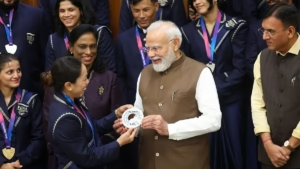
Prime Minister Narendra Modi hosted India’s Commonwealth Games 2026 contingent at his official residence, 7, Lok Kalyan Marg in New Delhi, praising the athletes for their extraordinary performances in Glasgow and asserting that their achievements have laid the foundation for a thriving national sporting culture. Interacting warmheartedly with the medallists, including para-athletes who received special commendation, the Prime Minister emphasised that their victories extended far beyond mere additions to the nation’s medal count.
He pointed out that every medal won on the international stage serves as a powerful beacon for young children across the country, instilling a sense of confidence and ambition that traditional classroom speeches or administrative outreach could never replicate on their own. Reflecting on the deeper social and psychological impact of their success, Prime Minister Modi highlighted how sustained athletic excellence over the past decade has fundamentally transformed India’s sporting ecosystem. He lauded the systematic contribution of grassroots initiatives like the Khelo India program, which continues to identify, nurture and elevate raw talent to the highest levels of global competition. During an emotional moment of the interaction with weightlifting icon Mirabai Chanu, who broke down while recalling her podium journey as the national anthem played, the Prime Minister remarked that every drop of her tears felt like a gold medal falling, symbolising the immense sacrifice, grit and pride behind India’s international triumphs. India’s fourth-place finish in the overall medal standings, earning a total of 39 medals comprising 13 gold, 17 silver and 9 bronze, is particularly remarkable given the heavily truncated format of the Glasgow 2026 Games. The host organisers had instituted a drastically reduced competition schedule that completely omitted several of India’s traditional stronghold disciplines, including wrestling, badminton, table tennis, hockey and shooting. Despite being deprived of these high-yield sports where Indian contingents historically dominate, the team adapted brilliantly, maximising their potential across combat, field, track and powerlifting disciplines to firmly maintain India’s spot among the global elite. The boxing ring proved to be a primary battleground for India’s dominance, yielding a total of 10 medals that are 7 gold and 3 silver, marking the finest performance by Indian women boxers in the history of the Commonwealth Games. Sensational gold medal performances by Preeti Pawar (54kg), Jaismine Lamboria (57kg), Sakshi Chaudhary (51kg), Priya Ghanghas (60kg), Arundhati Choudhary (70kg), Sachin Siwach (60kg) and Ankush Panghal (80kg) demonstrated unmatched technical prowess and mental fortitude. Complemented by silver medal efforts from Jadumani Singh, Lovlina Borgohain and Narender Berwal, the squad drew high praise from the Prime Minister, who noted with pride that boxers worldwide have genuinely begun to fear India’s combat discipline and formidable ring presence.
Beyond the boxing ring, Indian athletes etched their names into the record books across judo and track-and-field events with unprecedented feats. In judo, India delivered its best-ever Commonwealth Games performance by securing four medals, highlighted by historic gold medals from Khelo India prodigies Asmita Dey and Harsh Singh, who became the first Indian woman and man respectively to win CWG judo gold. Meanwhile, the athletics contingent brought home 10 medals, led by distance runner Gulveer Singh, who made history as the first Indian track and field athlete to capture two individual medals at a single CWG edition with a silver in the 10,000 meters and a bronze in the 5,000 meters. Concluding the ceremony, Prime Minister Modi urged the heroes of Glasgow to maintain their unyielding appetite for excellence, expressing full confidence that they will continue to conquer future international arenas and return to celebrate even greater victories together.
Distipanna Bhuyan