

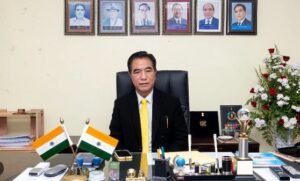
Mizoram Chief Minister Lalduhoma, alongside several leading Christian organisations across India, has formally urged the Union Government to refer the Foreign Contribution (Regulation) Amendment Bill, 2026 to a Joint Parliamentary Committee. The leaders have emphasised the need for a detailed parliamentary examination, broader public consultation and structured dialogue before the controversial legislation is brought up for passage during the ongoing Monsoon session of Parliament.
The push for parliamentary scrutiny intensified following a high-level delegation meeting in New Delhi, where Chief Minister Lalduhoma was accompanied by representatives from the Mizoram Kohhran Hruaitu Committee and the Council of Churches in Mizoram. During their meeting with Union Home Minister Amit Shah, the delegation submitted a detailed memorandum detailing key regional and institutional concerns regarding the proposed legislative changes. Emphasising a collaborative approach, CM Lalduhoma stated that sending the bill to a JPC reflects the “spirit of democratic consultation” required for transparent and inclusive policymaking. Adding significant weight to the demand, the Catholic Bishops’ Conference of India appealed to the Centre to halt the bill’s hasty passage and allow a JPC to evaluate its grassroots impact. Archbishop of Delhi and CBCI Secretary General, Most Rev. Anil Joseph Thomas Couto, clarified that while the Catholic Church fully supports national security and financial transparency, specific provisions in the bill risk creating severe operational barriers for institutions delivering crucial education, healthcare and humanitarian services nationwide.
The legislative tension stems from a sequence of recent regulatory moves by the Union Home Ministry. The Foreign Contribution (Regulation) Amendment Bill, 2026 was officially introduced in the Lok Sabha. The government notified revised FCRA rules requiring NGOs to choose operational areas from a strict and predefined list. Under these updated rules, proselytisation was explicitly excluded from eligible registration categories. Multiple representations were formally submitted to Union Home Minister Amit Shah by church bodies. Mizoram CM Lalduhoma, Christian apex bodies and civil rights leaders jointly reiterated their call for a JPC referral ahead of the bill’s scheduled discussion in the Lok Sabha. The National Council of Churches in India and the All India Christian Council have both strongly advocated for holding back the bill. NCCI General Secretary Asir Ebenezer pointed out major ambiguities surrounding the cessation of FCRA certificates and the proposed mechanism for a “Designated Authority” to take over NGO assets. Ebenezer stressed that the law lacks adequate administrative and judicial review mechanisms. At the present, the All India Christian Council President Joseph D’Souza referred to a JPC referral as the “only sensible way forward” to prevent the destabilisation of long-standing social institutions. A broad coalition of faith leaders and human rights advocates, including Cardinal Oswald Gracias, Aizawl Bishop Most Rev. Stephen Rotluanga, National Church Mission Association Chairman Richard Howell, United Christian Forum National Coordinator A.C. Michael, Rev. Dr. Sunil M. Caleb and activist John Dayal have joined the movement. They cautioned that social institutions serving marginalised communities take decades to establish and warned that passing the bill in its current form without incorporating civil society feedback could irreparably damage non-profit social work in India.
Distipanna Bhuyan