

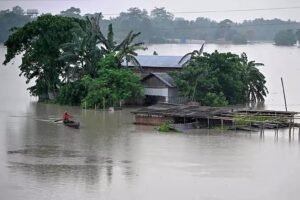
The recurring deluge in Assam has once again laid bare the severe human and economic toll of annual flooding across the state. The official flood death toll has reached 105, including 103 victims of flash and rural floods and 2 from urban flooding in Kamrup Metro and Morigaon districts. Currently about 147 villages across five districts like Golaghat, Sivasagar, Nagaon, Biswanath and Jorhat remain submerged. In response, 11 relief camps are housing 942 displaced residents, including 125 children. Relief operations, led by the Indian Army’s Red Shield Division alongside ARG Sankalp Trust, Lions Club, AIIMS Guwahati and NCC cadets, recently treated 931 civilians and 330 animals during a three-day medical and veterinary drive across Barhoiting village, Chintamoni Ghar and Nimaijan in Sivasagar district.
How Worst-Hit Are Women, Children and Livestock?
Children represent one of the most vulnerable groups during flood disasters in Assam, accounting for 17 deaths including 11 boys and 6 girls out of the 105 total casualties this season. Sivasagar district recorded the highest child mortality with six deaths, followed by Charaideo with five, Jorhat with four and Golaghat and Karbi Anglong with one each. Sudden flash floods give little lead time, leaving young children unable to navigate fast-moving waters. Beyond the tragic loss of life, over 125 children currently staying in relief camps face acute disruptions to their education, nutrition and psychological well-being. Women also face disproportionate hardship during these annual crises, with 23 female casualties recorded in the recent floods. Displaced women encounter severe challenges regarding sanitation, maternal health and physical safety in temporary relief shelters. The presence of volunteer gynaecologists and eye specialists at recent emergency relief camps reveal the critical and ongoing demand for specialised medical consultations for women and elderly survivors in flood-affected rural zones.
Livestock and domestic animals suffer immensely, representing an often-overlooked dimension of rural devastation. In agrarian hubs like Sivasagar and Golaghat, cattle and farm animals form the primary economic safety net for families. Floodwaters submerge extensive grazing lands, leaving animals stranded without fodder or clean drinking water, leading to starvation, drowning and high risks of waterborne diseases. The treatment of 330 animals during recent field camps highlights the urgent and large-scale veterinary support needed to prevent mass livestock loss during the monsoon.
Causes of Assam Floods
The perennial flooding in Assam is driven by a combination of unique geographical features, heavy seasonal precipitation and failing physical infrastructure. The narrow topography of the Assam valley causes the Brahmaputra and Barak rivers, along with their numerous hill-fed tributaries, to swell rapidly during heavy monsoon rain spells. Sudden cloudbursts and intense rainfall trigger unexpected flash floods in districts like Sivasagar and Charaideo, giving residents almost no time to evacuate safely. Compounding the problem is severe siltation and riverbed elevation caused by upstream deforestation and soil erosion. As sediment settles at the bottom of major rivers, their natural water-carrying capacity decreases significantly, forcing excess water to spill over into human settlements. Furthermore, much of the state relies on outdated earthen embankments built decades ago, which frequently breach under high hydraulic pressure, releasing catastrophic walls of water directly into surrounding villages.
How Floods Can Be Solved: Government Action Plan
Solving Assam’s chronic flood crisis requires the government to shift from reactive disaster response to a proactive and long-term structural strategy. A critical first step is the deployment of hyper-local, real-time flash flood early warning systems by the Assam State Disaster Management Authority. Combined with community-level awareness drives and mandatory flood safety training in rural schools, early alerts can directly reduce preventable drownings among children and vulnerable residents. On an engineering level, the government must invest in modernising flood protection infrastructure through systematic river desilting, channel dredging and the reinforcement of aging embankments using durable geo-textiles and concrete walls. Apart from that the disaster management plans must permanently incorporate specialised protocols for vulnerable groups including pre-constructed raised platforms or manti-tillas for livestock evacuation, stocked fodder banks and mobile medical units dedicated to maternal and child healthcare during flood season.
Distipanna Bhuyan